
We help refining and process-plant owners build digital transformation in stages — starting from basic integration and maturing toward a fully real-time digital twin (RWDT²) that drives margin, reliability and emissions performance continuously.
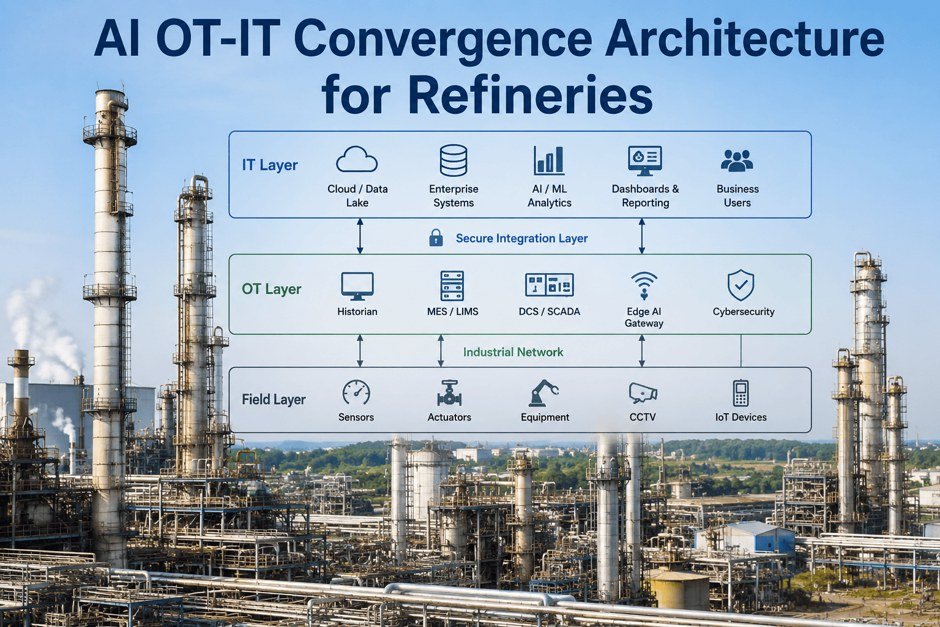
Level 1–2 — basic to complex refinery-wide integrated real-time optimisation, incl. AI-ML-enhanced RTO.
Level 3 — IT-OT convergence with MPC/APC, refinery modelled in real time.
Level 4 — margin, operations, crude-blend, energy/emissions optimisation, asset health & reliability.
Continuous improvement cycle embedding the digital twin into day-to-day decision-making.
Each AI-module combines process models, machine learning and agentic AI assistants that monitor, reason and recommend within your guardrails. The nine run in dependency order: a calibrated model feeds crude and quality prediction, then unit and energy optimisation, then the catalyst, reliability and safety limits, which together feed the site-wide margin and network plan and, finally, the automation of daily decisions. Choose a tool below to jump to it.
Keeps simulation and kinetic models calibrated to the plant through data reconciliation, then lets engineers test what-if scenarios on the live model before acting.
Evaluates opportunity crudes and blends with assay-based models, and predicts product properties continuously between laboratory samples so blending and control can run closer to specification.
Optimises unit set-points inside safe limits, predicts approaching constraints such as flooding, fouling and compressor limits, and identifies the active bottleneck so throughput is lifted without new equipment.
Combines energy and emissions optimisation with furnace performance monitoring (efficiency, excess O₂, hot spots, coil temperatures) and utilities performance monitoring (steam, power, hydrogen, fuel gas, flare).
Tracks catalyst activity, selectivity and remaining life against operating history, and links every operating or equipment change to a managed, auditable Management of Change workflow.
Combines condition monitoring with corrosion and reliability models to score asset health, predict failures, support preventive and predictive maintenance, and plan turnaround scope and timing.
Monitors operating envelopes, interlocks and transient modes such as start-up, shutdown and turndown, and flags safety-critical excursions early, with data to support HAZOP, SIL and OMAR reviews.
Finds the highest-margin operating plan for the whole complex from live data and prices, and balances crude, intermediates, products, tankage and logistics as one network, with inventory and working capital under control.
Automates repetitive daily work: shift reports, data validation, KPI dashboards, laboratory-to-model updates, alerts and routine decisions, so engineers spend time on analysis instead of spreadsheets.
We combine deep refinery operating and technical-services domain knowledge with established kinetic and refinery-wide simulation models to specify, scope and supervise digital-transformation projects — working as an independent, technology- agnostic advisor rather than a software vendor.
Where it accelerates delivery, we work alongside specialist technology and systems-integration partners rather than duplicating their platforms — see our About page for our collaboration approach.
Most clients begin with a focused IT–OT / RTO readiness assessment before committing to a full digital-twin programme — a natural extension of our Diagnostic SCAN approach.
Request a ProposalDisclaimer. PETRONOVA is independent and technology-agnostic and has no conflict of interest with any vendor, licensor or contractor. Benefits shown are indicative, not guaranteed. See our Legal Disclaimers, NDA & Confidentiality.